


A treatment plan before the first intervention
At White Castle, treatment does not start in the chair. It starts with a conversation, a proper examination and a written plan that you take home, read and approve. Only then do we book treatment appointments.
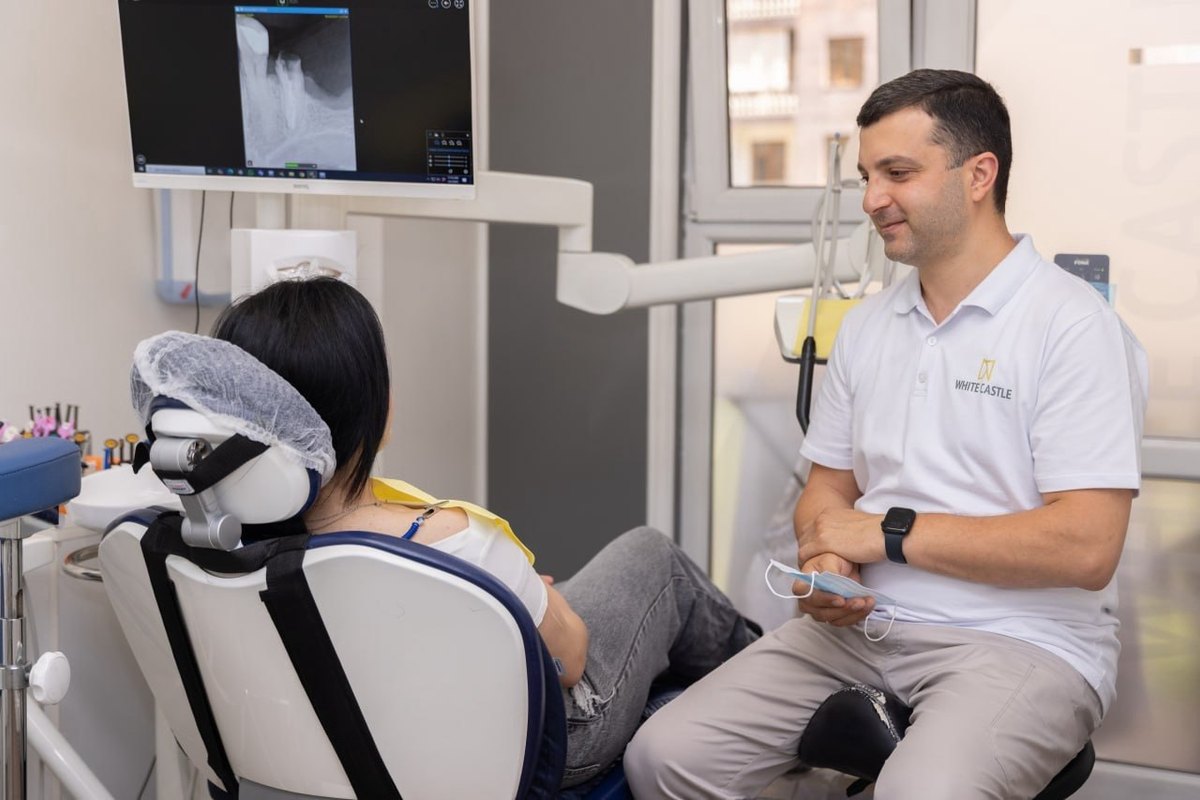
The stage that matters most
The long-term outcome of treatment is decided not in the chair but before it — at the point where we decide what to do, in what order, and why.
A perfectly made crown will fail if it is in the wrong place. A beautiful veneer will not last if the bite was never assessed. An implant will lose bone if periodontal disease was not stabilised before surgery. Most of these failures are prevented at the planning stage, which is why we treat planning as a service in its own right.
We do not book a treatment appointment until you have approved the plan. No exceptions.
How it works
Seven steps, from the first conversation to an approved plan. Straightforward cases fit into one visit; aesthetic and functional cases take several.
We listen
What concerns you, what you want to change, what your previous experience of dental care has been. This conversation is not rushed.
We assess expectations
What is realistic, over what timeframe and with what limits. If an expectation does not match what is possible, we say so now, not after treatment.
We plan the investigations
Not everyone needs everything. We decide which investigations will actually answer the questions in your case.
We carry them out
Examination under the microscope, radiographs, periodontal charting, photographs, and where needed a digital impression and CBCT.
We record every finding
Not only the one you came in for. Every tooth, every periodontal pocket, every existing restoration.
We send you a preliminary plan
In writing, with options, phases, timelines and cost. You read it at home, without pressure.
You approve it
Questions, adjustments, a second opinion — all fine. Appointments are booked only after approval.
Four questions the plan answers
In international practice, comprehensive planning is built not around individual teeth but around four areas. We work the same way.
Esthetics
Where should the teeth be?
Tooth position is judged against the face, lips and smile. The end result is visualised before anything is done.
Function
How do the jaws work?
Bite, jaw joint, chewing muscles. Without this assessment, even a perfect restoration will break.
Structure
What can be saved?
The condition of each tooth, whether it can be restored, its fracture risk. The decision: keep, restore or replace.
Biology
What must be stabilised first?
Periodontal health, bone support, caries risk. Without a stable foundation, any treatment is temporary.
This approach is known as Facially Generated Treatment Planning and is widely used in comprehensive restorative dentistry. The principle is simple: decide where you need to end up first, and only then how to get there.
Decay caught while it can still be stopped
Decay is a process, not a hole. At its earliest stage, while the enamel surface is still intact, it can be stopped and reversed without drilling. Missing that stage means a filling, then a larger filling, then a crown.
- Examination under the microscopeThe earliest enamel demineralisation, invisible to the naked eye, shows up under magnification.
- Bitewing radiographsDecay between teeth is found while it is still confined to enamel.
- Staging the lesionWe decide whether a lesion needs a filling or whether monitoring and remineralisation are enough. Not every mark needs drilling.
- Caries risk assessmentDiet, saliva, hygiene, past decay, medication. The risk level sets how often you need to be seen.
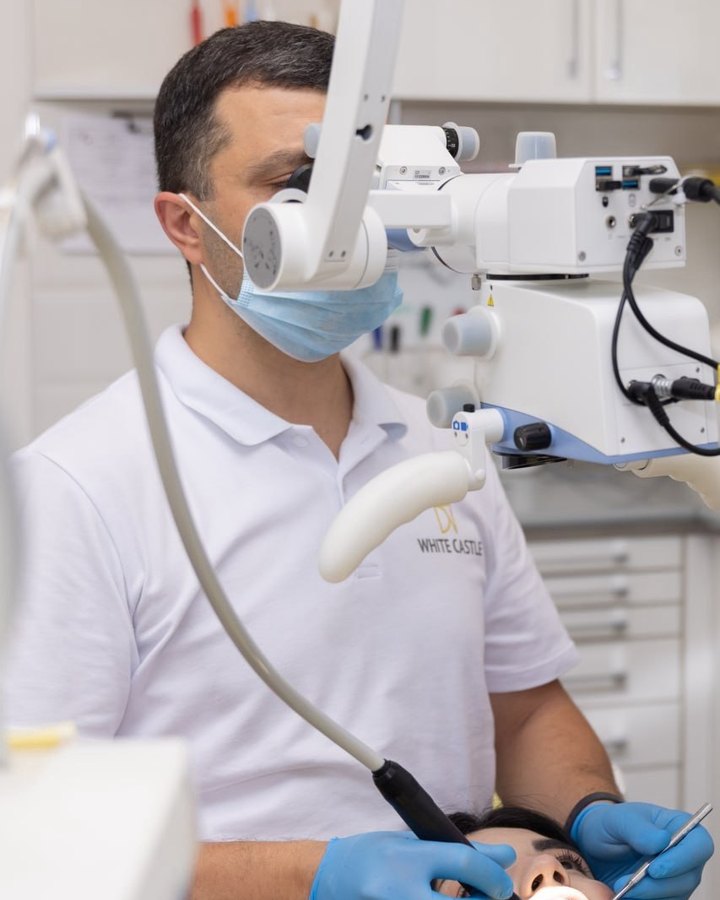
Examination under the microscope is the diagnostic standard for every patient.
The plan is divided into phases
This is a core principle of international practice: expensive definitive treatment does not start until disease is under control.
Urgent
Pain, infection, a broken tooth. Dealt with straight away, regardless of the rest of the plan.
Disease control
Treating decay, periodontal therapy, hygiene coaching.
Re-evaluation
We check how your mouth has responded. The plan is adjusted if needed.
Definitive treatment
Crowns, veneers, implants, orthodontics, full rehabilitation.
Maintenance
Review visits set by your risk level, not by the calendar.
A phased structure also lets you spread the time and cost of treatment. You know what will happen, when, and what each step costs.
What you receive
The preliminary treatment plan is a written document that stays with you. You can show it to your family, to another dentist, or keep it for later.
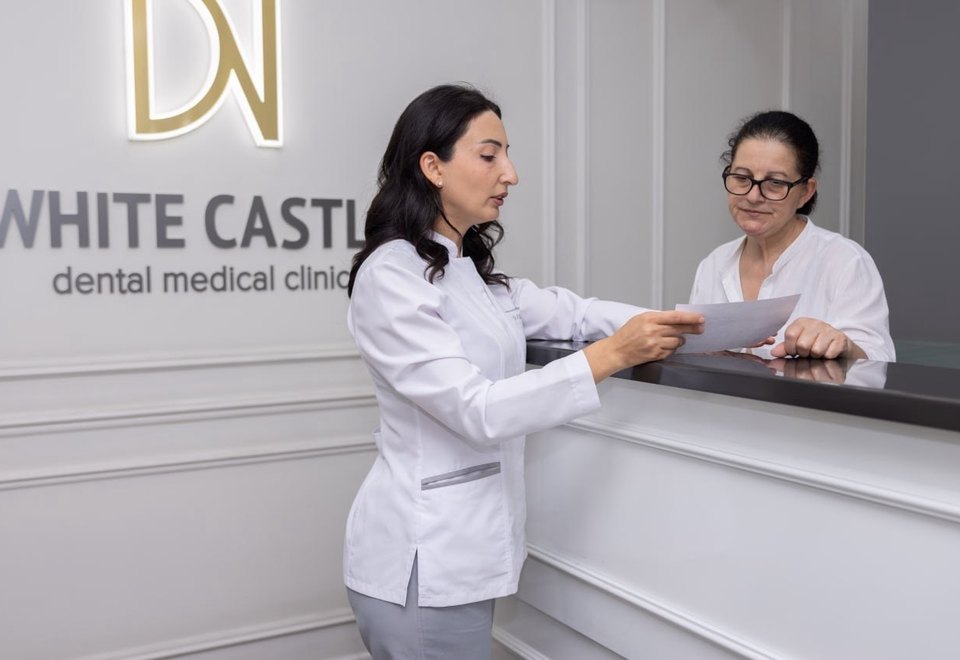
The coordinator walks through the plan and answers questions before approval.
- Every finding — at the level of individual teeth and tissues
- The diagnosis — explained in plain language
- Treatment options — usually two or three, with their advantages and limitations
- Phases and sequence — what comes first and why
- Timelines — for each phase and for treatment as a whole
- Cost — by phase, with no hidden extras
- What happens if nothing is done — an honest assessment, so the decision is an informed one
When planning takes more than one visit
For patients with aesthetic and functional concerns, planning is the stage where saving time costs the most.
- Changing your smilePhotographs, a digital impression and a mock-up of the result before any tooth preparation.
- Worn teethAssessment of bite height and jaw relationship on an articulator.
- Several missing teethImplant number and position planned from CBCT — starting from where the future crowns need to be.
- Full rehabilitationSeveral specialists involved, one coordinator responsible for the whole plan.
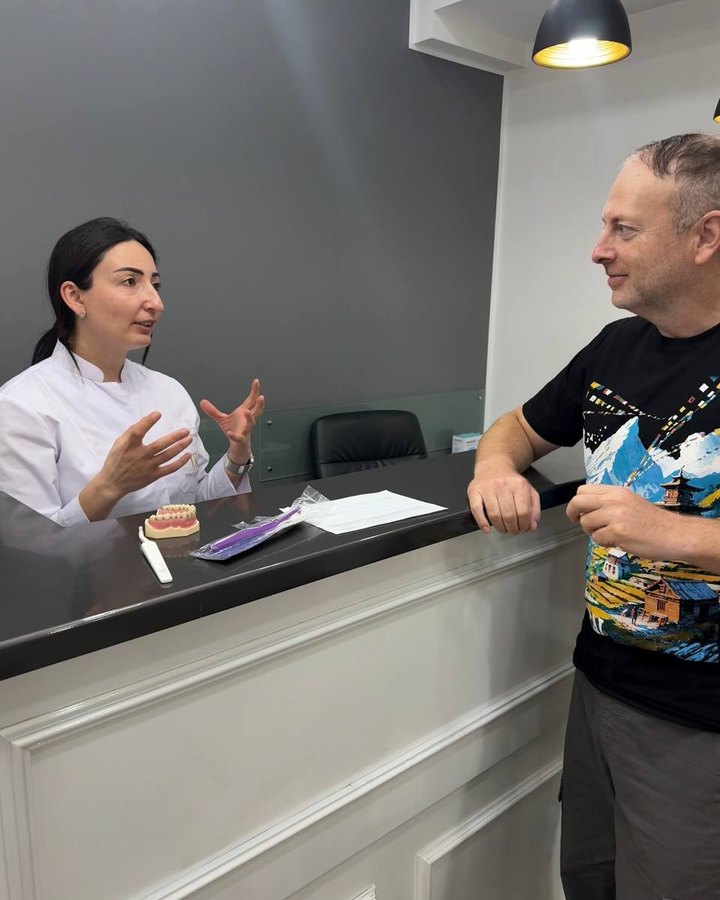
Plans are explained with models and images, not just in words.
Who draws up the plan
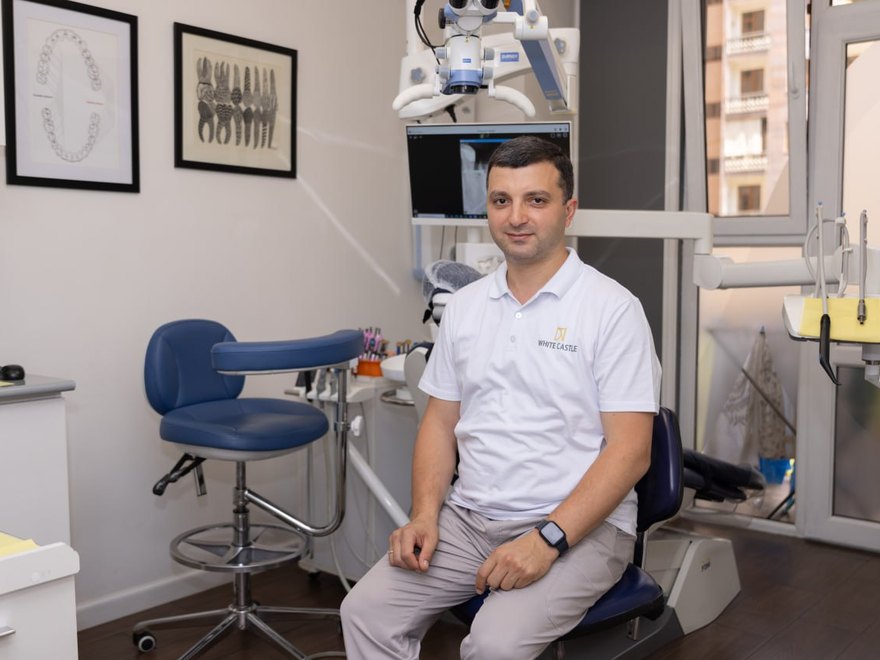
Dr. Davit Hovhannisyan
Founder of the clinic, treatment planning coordinator
Treatment plans at White Castle are drawn up and coordinated by Dr. Davit Hovhannisyan. More than 19 years in clinical practice, at White Castle since 2010. His focus: restorative, aesthetic and implant dentistry, and periodontics.
In complex cases the plan is built by a team. Each specialist assesses their own area, and the coordinator brings it together into one consistent plan.
Orthodontist
When moving teeth would preserve more tissue than restoring them.
Endodontist
When the question is whether a tooth can be saved.
Dental technician
When the planned work is modelled before treatment begins.
Frequently asked questions
Why not start treatment at the first visit?
Because until the full picture is in, any treatment could turn out to be the wrong one. The exception is acute pain, which we deal with immediately.
How many visits does it take?
One for straightforward cases. Several for aesthetic, functional or complex ones, because modelling and specialist input take time.
Do I have to be treated at your clinic?
No. The plan is yours. You can take it to another dentist or use it for a second opinion.
Why several options?
Because the ideal solution does not always fit a patient’s time, budget or wishes. We show the price of each option — biological as well as financial.
Can the plan change?
Yes. After re-evaluation, the plan is adjusted to how your mouth has responded. Any change is agreed with you first.
I only came in about one tooth
We will treat that tooth. But if we see another problem during the examination, we will tell you. The decision stays with you.
Start with the plan
A conversation, a full examination and a written treatment plan — with options, phases, timelines and cost.
White Castle Dental Clinic · +374 12 336699 · 6/1 Nikoghayos Adonts St., Yerevan 0014, Armenia