


The Clinic and How It Works
White Castle is built around one idea: the outcome of treatment is decided not by a single machine, but by how carefully every stage is structured — from diagnosis through to instrument reprocessing.
The clinic follows international protocols. Every operatory has a microscope, diagnostics are fully digital, and instruments go through an automated, validatable reprocessing cycle. We work only with certified materials and equipment from established manufacturers.
The clinic has fully digital operatories, a dedicated sterilization area, rooms for implant surgery, endodontics and aesthetic dentistry, and a patient lounge.
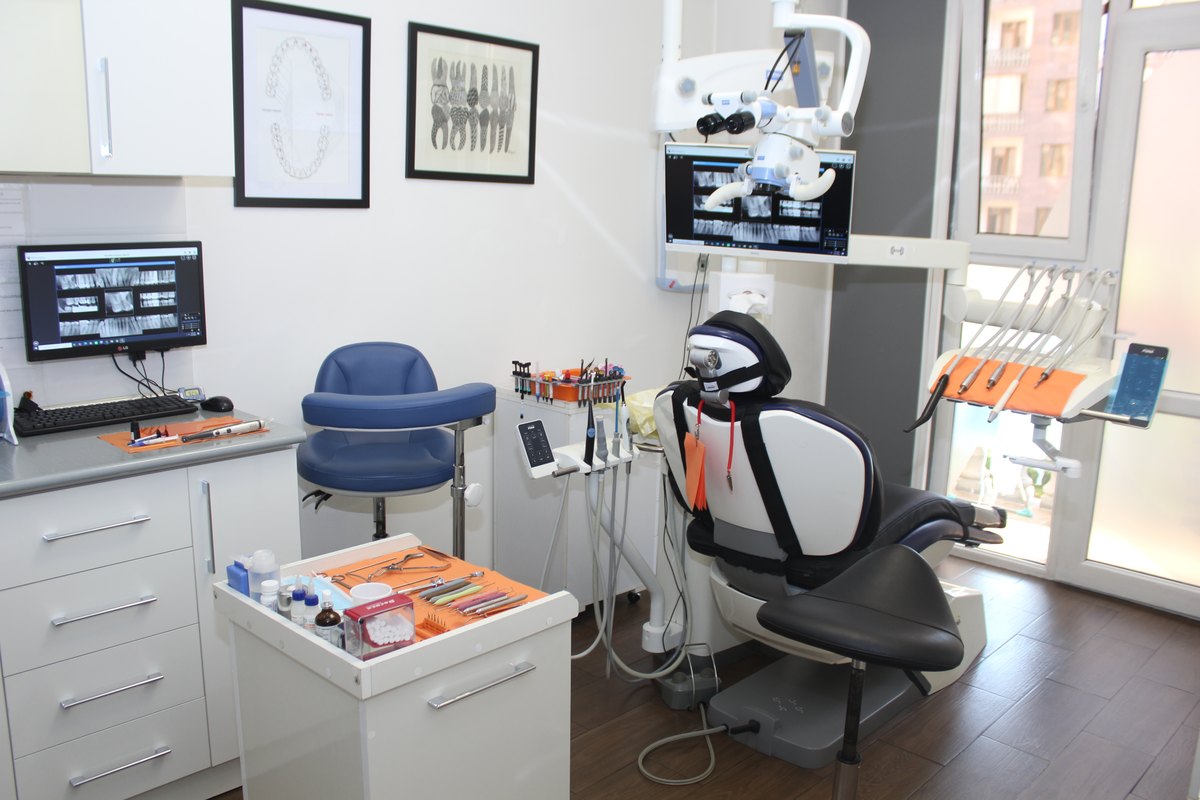
An operatory: microscope, two screens for radiographs and the patient chart, Fona unit.
Six things the clinic is built on
None of these is a list of equipment. Each one is a protocol with defined steps and a way to check the result.
Digital diagnostics
Medit intraoral scanner, CBCT, full-mouth intraoral series and bitewings, computerised periodontal charting with Florida Probe.
Optics and magnification
Zumax microscopes and loupes — for every clinician, in every operatory. This is a required standard here, not an option.
Dedicated page in preparation
Sterilization and safety
Automated Mocom Tethys H10 Plus cycle, heat sealing, autoclaving and documentation of every stage. Manual scrubbing has been eliminated.
Dedicated page in preparation
Color Method — instrument management
Colour coding by type of treatment and the Zirc cassette system. An instrument never leaves its set, cabinet to cabinet.
Dedicated page in preparation
Prevention and hygiene
Guided Biofilm Therapy on the GBT Machine by EMS, EMS and Acteon ultrasonic scalers, and Dr. Naira’s Hygiene School.
Planning and articulation
SAM articulators for accurate transfer of occlusion, photo and video protocol, digital modelling of the planned work.
Dedicated page in preparation
Optics: magnification as a required standard
A microscope stands in every operatory and is used by every clinician, not only in endodontics. That decision cost more, and it is what determines the quality of every single case.
- Precision endodonticsCanal orifices, cracks and separated instruments are seen, not guessed at.
- Minimally invasive treatmentOnly diseased tissue is removed. Healthy enamel and dentine stay where they are.
- Accurate marginal fitThe restoration margin and preparation finish line are checked under magnification.
- The patient sees what the clinician seesThe camera feed is shown on the operatory screen.
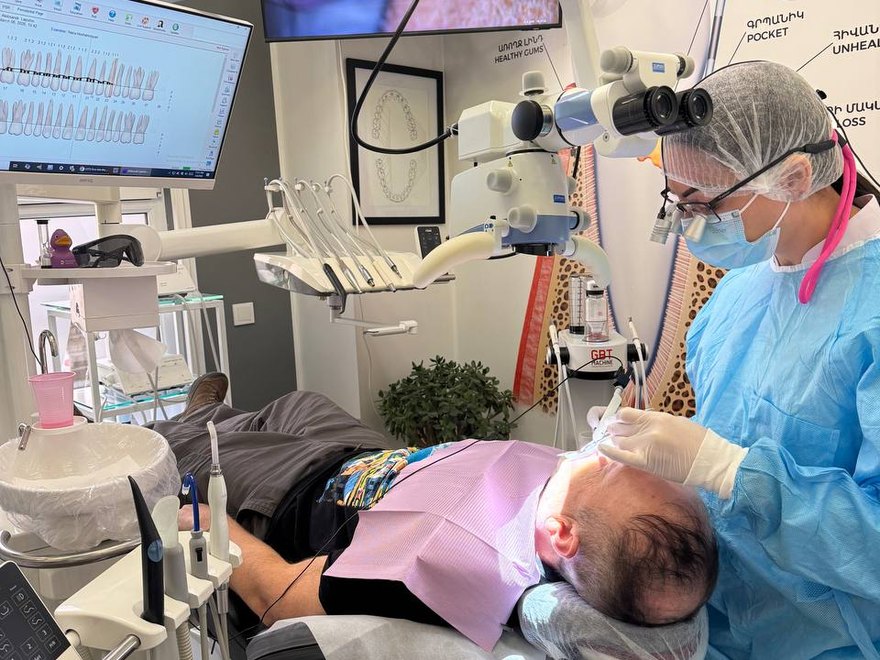
Treatment under magnification. On the left, the Florida Probe periodontal chart; above, the camera feed.
Sterilization: a cycle we can prove
Manual scrubbing of instruments has been removed from this clinic entirely. Its quality depends on fatigue and the shift, and it cannot be verified. An automated cycle records temperature, time and pressure.
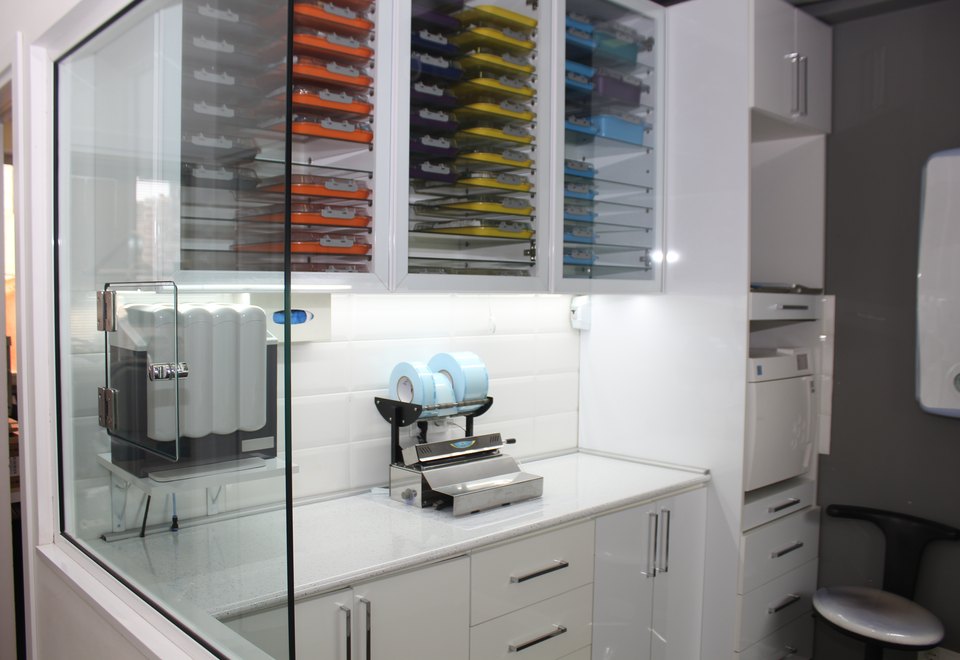
The sterilization area is separated from the clinical area. Dirty and clean sides are physically divided.
- Mocom Tethys H10 PlusDecontamination, washing, thermal disinfection and drying in one cycle. The cassette goes in closed and comes out closed.
- Separated zonesThe dirty zone uses black gloves only. The clean zone, light blue only. The two routes never cross.
- Heat sealing and autoclavingEvery set is pouched and sterilised with process indicators.
- DocumentationEvery stage is logged. We can show how any given set was reprocessed.
Color Method: the instrument never leaves its set
Lost instruments, sets mixed between clinicians, and drawers being opened throughout a procedure are not a sterilization problem. They are a logistics problem. We solved it with colour coding and the Zirc cassette system.
- Colour follows the treatment, not the clinicianNot the operator, not the room. That matters: the set is identical regardless of who is working.
- The set stays closed, cabinet to cabinetThe cassette is not opened in the sterilization room. Sorting disappeared as a step.
- The assistant does not leave the chairIf something outside the set is needed mid-procedure, the set was assembled wrong.
- A new assistant learns in daysIt used to take weeks. The colour answers the question of where an instrument belongs.
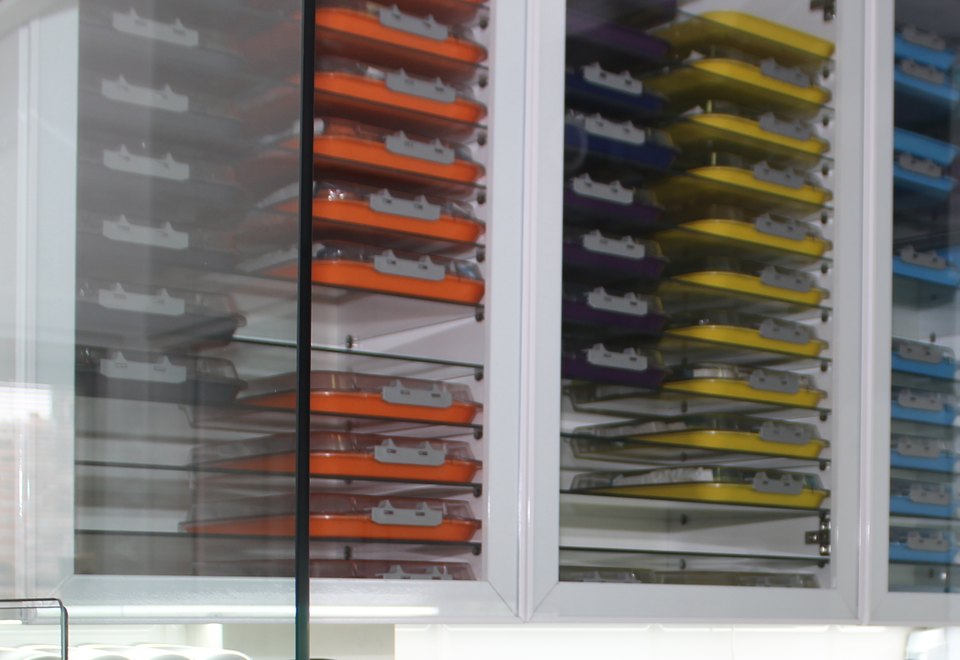
Six colours, six standard sets. Each one stocked to a fixed list.
The path of an instrument: seven checkpoints
At every handover the set is confirmed complete with a signature. An incomplete set is not accepted and goes back one step.
Cabinet
A tray stocked in full against the standard list.
Operatory
The set is opened at the chair; the container goes back to its place.
Treatment
Four-handed work, with clean and dirty fields kept apart.
Handover
Log entry: date, patient, clinician, instrument list, signature.
Reprocessing
The cassette is not opened. Automated Tethys H10 Plus cycle.
Autoclave
Pouching, heat sealing, sterilization, cycle monitoring.
Return
Restocked against the standard list and returned to the cabinet.
Digital diagnostics and planning
A treatment plan is built on data, not on impression. Everything we see is recorded and can be shown to the patient.
- Medit intraoral scannerA digital impression without tray or impression material, and on-screen modelling of the planned work.
- Full-mouth intraoral series and bitewingsHidden and interproximal decay, bone level, inflammatory lesions at the root apex.
- CBCTThree-dimensional implant planning, assessment of bone volume and anatomical structures.
- Florida ProbeComputerised periodontal charting to the millimetre, with tracking over time.
- Photo and video protocolThe starting condition is recorded before treatment begins and compared against the result.
- SAM articulatorsAccurate transfer of occlusion and chewing dynamics to the laboratory.
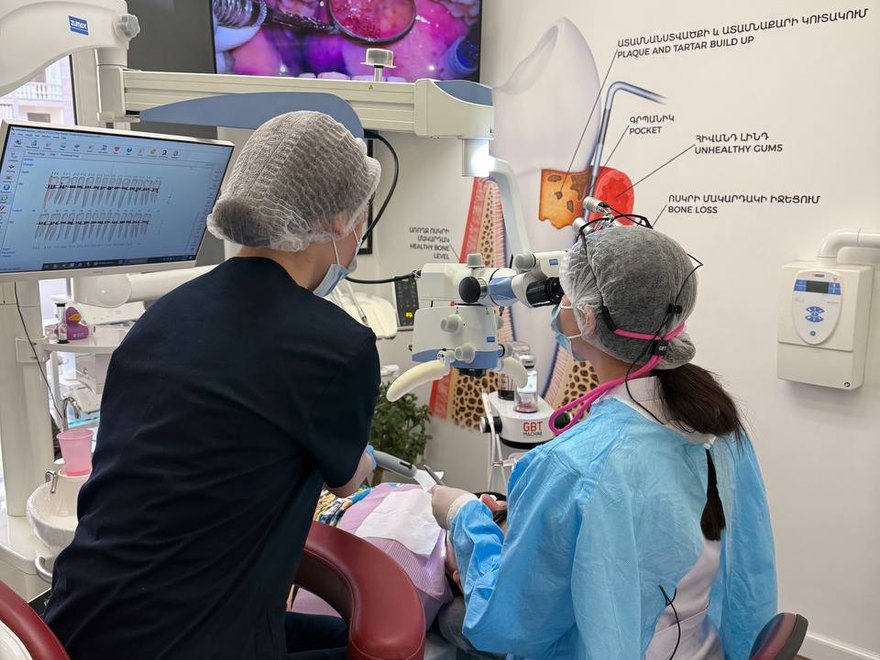
The periodontal chart and camera feed are displayed on screen during the procedure.
Materials, instruments and laboratory
We work only with certified manufacturers. The main ones, grouped by area:
Implantology and surgery
Nobel Biocare · Alpha-Bio · Geistlich · OsteoBiol · Piezosurgery
Optics and hygiene
Zumax · EMS · Acteon · Bien-Air · Florida Probe
Restorative
Voco · Admira · Micerium · Ultradent · Kerr · 3M ESPE · DMG
Instruments and sterility
Hu-Friedy · LM Dental · Zirc · Mocom · Melag · Cattani
Esthetic & Functional Dental Lab — the laboratory of Aram Abgaryan
Veneers, crowns and bridges, implant-supported restorations, functional rehabilitation and aesthetic smile work. The laboratory combines hand craft with digital workflows, which is what gives predictable fit and aesthetics.
Rubber dam as standard
Rubber dam isolation is used in every operative and endodontic procedure. It is not an option and not an add-on: without isolation, the outcome of a restoration is not predictable.
Come and see it
We show the clinic to patients and to colleagues — the sterilization room, the operatories, and how the reprocessing cycle actually runs. Book a diagnostic consultation, or simply a visit to see the clinic.
White Castle Dental Clinic · +374 12 336699 · 6/1 Nikoghayos Adonts St., Yerevan 0014, Armenia